

 English
 中文简体
中文简体 русский

 +86-15021943462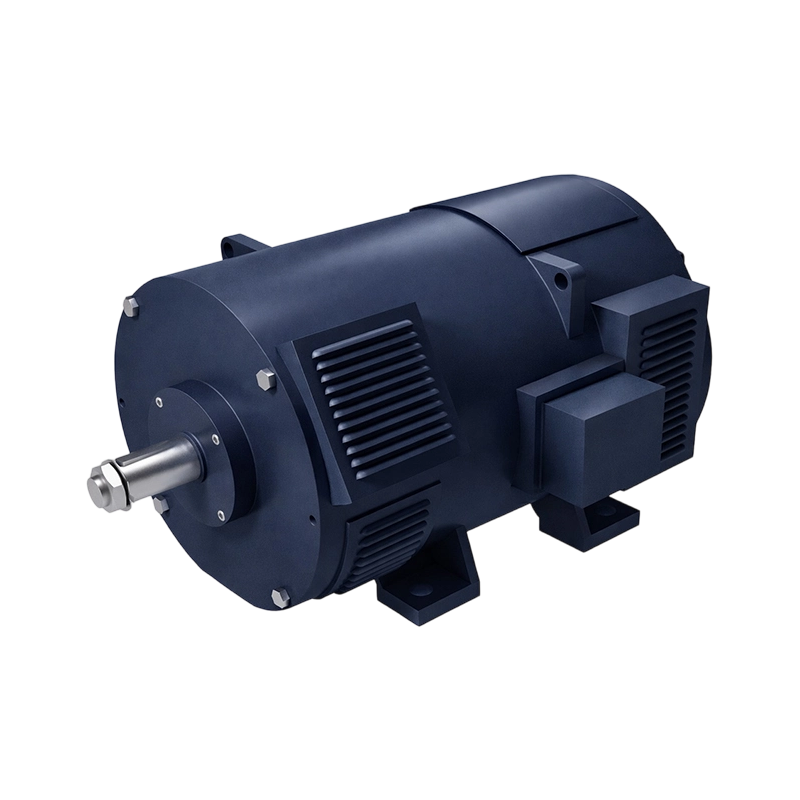

What Makes a DC Motor Suitable for Crane and Metallurgical Duty
Not every DC motor is built for the punishment of crane and metallurgical service. The distinction lies in how the machine handles thermal cycling, mechanical shock, and the relentless repetition of starts, plugging stops, and reversals that define these duty profiles. Crane Duty DC Motors are specifically engineered to withstand these conditions — and the differences between them and general-purpose DC machines go well beyond a nameplate rating.
Key design features that distinguish crane and metallurgical-grade DC motors include:
- Reinforced commutator construction — heavier segment profiles and improved mica insulation to survive high-frequency current reversals without bar lift or flashover
- Class F or H winding insulation — mandatory for applications where duty cycle generates repeated thermal spikes well above continuous rated temperature
- Robust brush gear — spring-loaded holders with consistent contact pressure across the full speed range, including near-zero speed during slow spotting maneuvers
- High short-time overload capacity — typically 2.5× to 3.5× rated torque for brief periods, allowing the motor to absorb shock loads during load pickup on overhead cranes or ladle transfer cars
- Vibration-resistant bearing housings — designed to maintain alignment under the structural vibration transmitted through crane bridges and trolleys
ICEM Electric sources these motors from manufacturing partners whose production processes specifically address crane and metallurgical duty requirements — not companies that repurpose standard industrial DC frames for demanding service conditions.
Duty Class and Thermal Rating: Reading the IEC and GOST Standards Correctly
One of the most common specification errors in procuring Metallurgical Industry DC Motors is misapplying duty class designations. IEC 60034-1 defines duty types S1 through S10, but crane and hoist applications typically fall under S3 (periodic duty), S4 (intermittent periodic duty with starting), or S5 (intermittent periodic duty with electric braking) — each carrying a specific cyclic duration factor (CDF) that determines how the motor's thermal capacity is calculated.
In the Russian and CIS markets, GOST R 52776 (equivalent to IEC 60034-1) and legacy GOST 183 standards remain the reference framework for motor acceptance. For metallurgical applications, the relevant crane duty classifications under these standards correspond to operating regimes with CDF values of 25%, 40%, or 60% — meaning the motor is energized for that percentage of a defined cycle period.
| Duty Type | Typical CDF | Typical Application |
|---|---|---|
| S3 | 25–40% | Storage yard cranes, light workshop hoists |
| S4 | 40% | Bridge cranes, charging machines |
| S5 | 40–60% | Ladle cranes, teeming cranes, coil handling |
Specifying the wrong duty class — for instance, using an S3/25% rated motor in a ladle crane running at 60% CDF — leads to accelerated insulation aging and premature winding failure, often within the first year of operation. Confirming the actual operating cycle before issuing a purchase inquiry is not a bureaucratic formality; it is the single most important input for correct motor selection.
Drive System Compatibility: DC Motors in Modern Variable-Speed Crane Drives
Despite the widespread adoption of AC variable frequency drives in many industrial sectors, separately excited DC motors paired with thyristor converters (Ward-Leonard or static converter drives) remain the preferred solution in a significant share of metallurgical crane installations — particularly in facilities across Eastern Europe and CIS countries where existing drive infrastructure was built around DC technology and replacing it entirely is not economically justified.
In these systems, the DC motor's armature voltage is varied by the converter to control speed, while the field excitation is independently controlled to allow field weakening above base speed. For crane hoist drives, this architecture provides precise speed regulation down to creep speeds of 1–5% of rated — essential for accurate load positioning in casting bays and hot metal handling areas.
When specifying DC motors for converter-fed drives, key parameters to align include armature voltage rating, field voltage and resistance, maximum permissible armature current during braking, and the motor's flywheel effect (GD²) — which influences the dynamic response of the speed control loop. Our technical team assists clients in matching motor characteristics to the specific converter type already installed on site, avoiding the commissioning complications that arise from mismatched drive-motor pairs.
Sourcing Heavy-Duty Hoist Motors for Cross-Border Projects: Logistics and Documentation
For industrial facilities operating in Russia, Kazakhstan, Ukraine, or other CIS markets, working with a qualified Heavy-Duty Hoist Motors Exporter requires attention to a set of supply chain requirements that go beyond technical specification. Large DC motors for crane and metallurgical service are typically custom-built or semi-custom, with lead times of 8–20 weeks from order confirmation — making early procurement planning essential for project schedules.
Documentation requirements for cross-border shipments in these markets typically include:
- Factory test protocol — routine test results per IEC 60034 or GOST, signed and stamped by the manufacturer's QC department
- Certificate of conformity — EAC (Eurasian Conformity) marking where required for equipment operating in the Eurasian Economic Union
- Dimensional and weight data — verified packing list with net/gross weight, crate dimensions, and center-of-gravity markings for large frame motors
- Spare parts package — brush sets, bearing kits, and commutator maintenance consumables are typically quoted and shipped with the motor to reduce long-term downtime risk
- Installation and maintenance manual — in Russian or the end-user's local language for metallurgical plant maintenance teams
Coordinating all of these elements across manufacturer, freight forwarder, and end-user is a core part of the export service model we have built since 2018 — ensuring that motors arrive on site ready for installation, not delayed at customs for missing paperwork.


