
 English
 中文简体
中文简体 русский

 Read More

Product Category
NEW Category
Contact us
Contact Us
We specialise in the research, development and manufacture of electrical wires and cables.
 +86-15021943462
AC Electric Motors: Parts, Types, Wiring & How They Work
Content
How an AC Motor Works
An AC motor converts alternating current electrical energy into mechanical rotational energy through the principle of electromagnetic induction. When AC supply voltage is applied to the stator windings, it generates a rotating magnetic field (RMF). The speed at which this field rotates is called the synchronous speed, determined by the supply frequency and the number of magnetic pole pairs in the stator: Ns = 120f / P, where f is supply frequency in Hz and P is the number of poles.
In an induction motor — the most common AC motor type — the rotating magnetic field cuts across the rotor conductors and induces a current within them by Faraday's law. That induced current produces its own magnetic field, and the interaction between the rotor field and the stator's rotating field generates a torque that drives the rotor to spin. The rotor always runs slightly slower than the synchronous speed; this speed difference is called slip, typically 2–8% in standard induction motors. Without slip, no relative motion exists between the field and rotor conductors, no current is induced, and no torque is produced.
In synchronous AC motors, the rotor is instead excited by a DC field or uses permanent magnets, locking it to rotate at exactly synchronous speed with zero slip. This makes synchronous motors the preferred choice where precise constant-speed operation is critical, such as in clock mechanisms, certain textile machinery, and high-efficiency variable-speed drives.
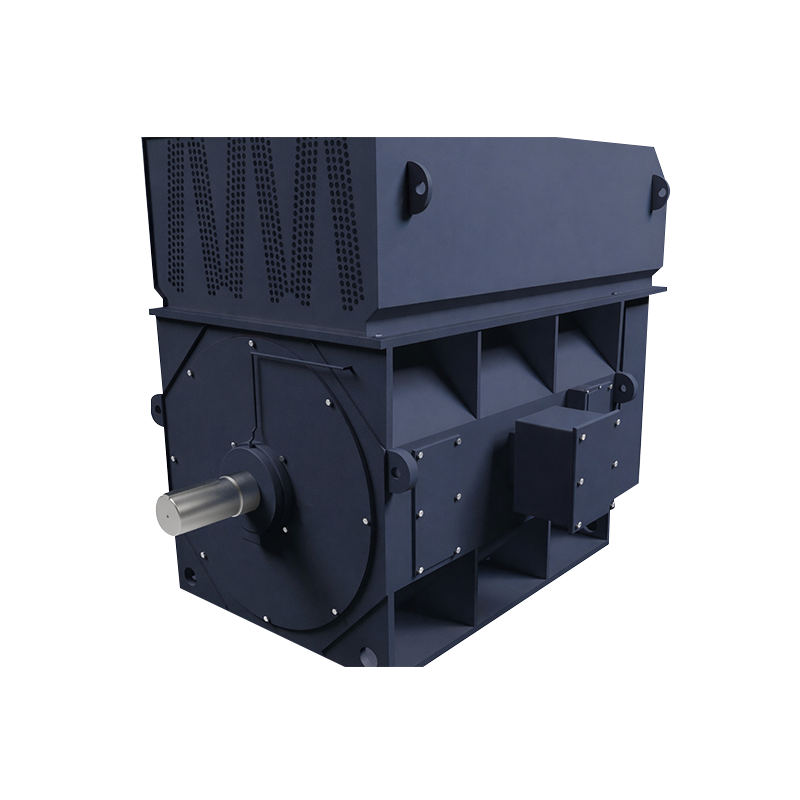
Parts of an AC Motor
Understanding the internal architecture of an AC motor helps with specifying the right unit, diagnosing faults, and planning maintenance intervals. The major components are:
- Stator: The stationary outer assembly that houses the laminated iron core and copper windings. The stator core is built from thin silicon steel laminations stacked together to minimize eddy current losses. The windings are wound into slots in the core and connected to the AC supply.
- Rotor: The rotating inner assembly mounted on the output shaft. In squirrel-cage induction motors, the rotor consists of aluminum or copper conductor bars short-circuited at each end by end rings. In wound-rotor motors, the rotor carries three-phase windings connected to external resistors via slip rings.
- Output shaft: The solid steel shaft that transfers mechanical torque to the driven load. Shaft diameter and keyway dimensions are standardized under IEC or NEMA frame size specifications.
- Bearings: Typically deep-groove ball bearings at the drive end (DE) and non-drive end (NDE). Bearings support the radial and axial loads imposed by the rotor and the driven load, and are the most common maintenance replacement item.
- End shields (end bells): Cast iron or aluminum housings that cap each end of the motor frame, holding the bearings in position and enclosing the internal assembly.
- Fan and fan cover: Most AC motors are TEFC (Totally Enclosed Fan Cooled) design, with an external cooling fan mounted on the non-drive end shaft extension, enclosed by a pressed-steel fan cover. The fan draws ambient air over the motor frame fins to dissipate heat.
- Terminal box (junction box): A weatherproof housing on the motor frame that contains the winding connection terminals (typically labeled U1, V1, W1, U2, V2, W2 under IEC convention). This is where supply cables and any star/delta configuration links are connected.
- Frame: The outer structural body, usually ribbed cast iron or aluminum alloy, that provides mechanical support, acts as a heat sink, and carries the mounting feet or flange for installation.
Additional components present in specific motor types include slip rings and brushes (wound-rotor induction motors), centrifugal starting switches (single-phase capacitor-start motors), and capacitors (single-phase run-capacitor and capacitor-start/run designs).
Types of AC Electric Motors
AC motors divide into two primary families — induction (asynchronous) and synchronous — each with several subtypes optimized for different operating requirements.
| Motor Type | Supply | Key Characteristic | Typical Applications |
|---|---|---|---|
| Squirrel-cage induction | 3-phase | Simple, robust, low maintenance; runs with slip | Pumps, fans, compressors, conveyors |
| Wound-rotor induction | 3-phase | External rotor resistance allows high starting torque and speed control | Cranes, hoists, large mills |
| Permanent magnet synchronous (PMSM) | 3-phase (via VFD) | High efficiency (IE4/IE5), no rotor copper loss, runs at synchronous speed | HVAC, servo drives, EV traction |
| Capacitor-start induction | Single-phase | Capacitor in series with start winding creates phase shift for starting torque | Air compressors, refrigeration, pumps |
| Capacitor-start / capacitor-run | Single-phase | Two capacitors: one for starting, one for running; higher efficiency than capacitor-start only | Woodworking machinery, power tools |
| Shaded-pole motor | Single-phase | Very simple construction, low starting torque, low efficiency | Small fans, appliances, vending machines |
| Reluctance synchronous | 3-phase (via VFD) | No rotor windings or magnets; torque produced by rotor saliency; IE4-capable | Industrial pumps, fans with VFD |
For the majority of industrial applications, the three-phase squirrel-cage induction motor remains the default choice. It requires no brushes, slip rings, or external excitation, making it the lowest-maintenance and most cost-effective option for constant-speed loads. Variable-frequency drives (VFDs) have extended its usability to variable-speed applications that previously required DC or wound-rotor motors.
AC Motor Wiring Diagram Basics
Wiring an AC motor correctly is essential for safe operation and achieving the correct torque and speed characteristics. The terminal box configuration varies by motor type and supply voltage, but the following covers the most widely encountered scenarios.
Three-Phase Dual-Voltage Motors (Star / Delta)
Most three-phase induction motors are wound for two voltage levels — commonly 230V/400V or 400V/690V — and the terminal box contains six leads labeled U1, V1, W1 (winding starts) and U2, V2, W2 (winding ends). The supply voltage determines the connection:
- Star (Y) connection — higher voltage: Link U2, V2, and W2 together to form the neutral star point. Connect the three-phase supply to U1, V1, W1. Each winding sees phase-to-neutral voltage. Used when supply voltage matches the motor's higher rated voltage (e.g., 400V supply on a 230/400V motor).
- Delta (Δ) connection — lower voltage: Link U1 to W2, V1 to U2, W1 to V2, forming a closed loop. Connect three-phase supply across each pair of joined terminals. Each winding sees full line-to-line voltage. Used when supply voltage matches the motor's lower rated voltage (e.g., 230V supply on a 230/400V motor).
Star-Delta starting is a common soft-start method for large motors: the motor starts in star (reduced voltage across each winding = lower starting current, typically 1/3 of direct-on-line inrush), then switches to delta once it approaches full speed. This reduces supply disturbance but also reduces starting torque by the same 1/3 factor, so it is only suitable for low-load starting applications.
Single-Phase Motor Wiring
Single-phase AC motors require an auxiliary starting circuit because a single-phase supply alone cannot produce a rotating magnetic field. The terminal arrangement typically includes:
- Main winding terminals (M): Connected directly across line and neutral.
- Start winding terminals (S): Connected in parallel with the main winding but in series with the starting capacitor. The capacitor creates a phase displacement (approximately 90°) between main and auxiliary winding currents, producing a rotating field strong enough to develop starting torque.
- Centrifugal switch or PTC relay: Disconnects the start winding once the motor reaches approximately 75–80% of synchronous speed. Failure of this switch — either staying open (motor won't start) or staying closed (start winding overheats and burns out) — is one of the most frequent single-phase motor faults.
Motor Rotation Reversal
Reversing the direction of rotation of a three-phase motor requires swapping any two of the three supply phases at the motor terminals — for example, exchanging the connections at U1 and V1. This reverses the direction of the rotating magnetic field and consequently the rotor. For single-phase motors, reversal is achieved by swapping the start winding connections relative to the main winding; some motors provide dedicated terminal markings for this purpose, while others require internal reconnection.
Earthing and Overload Protection
Every AC motor installation must include a protective earth (PE) connection bonded to the motor frame, connected to the supply earth at the terminal box. In addition, a properly rated thermal overload relay or electronic motor protection relay should be installed in the supply circuit, set to the motor's full-load current (FLC) rating. Overload protection is the primary defense against the most common motor failure mode: prolonged overcurrent from mechanical overload, single-phasing, or restricted ventilation that elevates winding temperature beyond the insulation class limit.
PREV:Crusher Duty Synchronous & High-Torque Pulverizer Motors Guide
NEXT:What Is an AC Motor, How It Works & How to Troubleshoot Electric Motors
NEXT:What Is an AC Motor, How It Works & How to Troubleshoot Electric Motors
Interested in cooperation or have questions?
Let'S Work Together Welcome Aboard!
-

-
 +86-15021943462
 -
 Room 2326, 23rd Floor 2000 Zhongshan North Road Putuo District Shanghai, China
Join Our Mailing List
Product Categories
Quick Links
Quick Links
