
 English
 中文简体
中文简体 русский

 Read More

Product Category
NEW Category
Contact us
Contact Us
We specialise in the research, development and manufacture of electrical wires and cables.
 +86-15021943462
AC Motor Guide: Types, Efficiency, Torque & Troubleshooting Tips
Content
What Is an AC Motor
An AC motor is an electric motor powered by alternating current (AC), the same type of current delivered by standard utility grids worldwide. It converts electrical energy into mechanical rotational energy through electromagnetic induction or magnetic field interaction—without requiring direct electrical contact between stationary and rotating parts in most designs.
The operating principle relies on a rotating magnetic field produced by the stator (the stationary outer assembly). This field either induces current in the rotor (induction motors) or locks the rotor to the field magnetically (synchronous motors). The result is continuous shaft rotation suitable for driving pumps, fans, conveyors, compressors, and hundreds of other industrial and commercial loads.
AC motors dominate industrial applications for several practical reasons: they operate directly on grid power without conversion, require minimal maintenance due to the absence of brushes in most types, and are available in standardized frame sizes and power ratings from fractional horsepower to several megawatts.
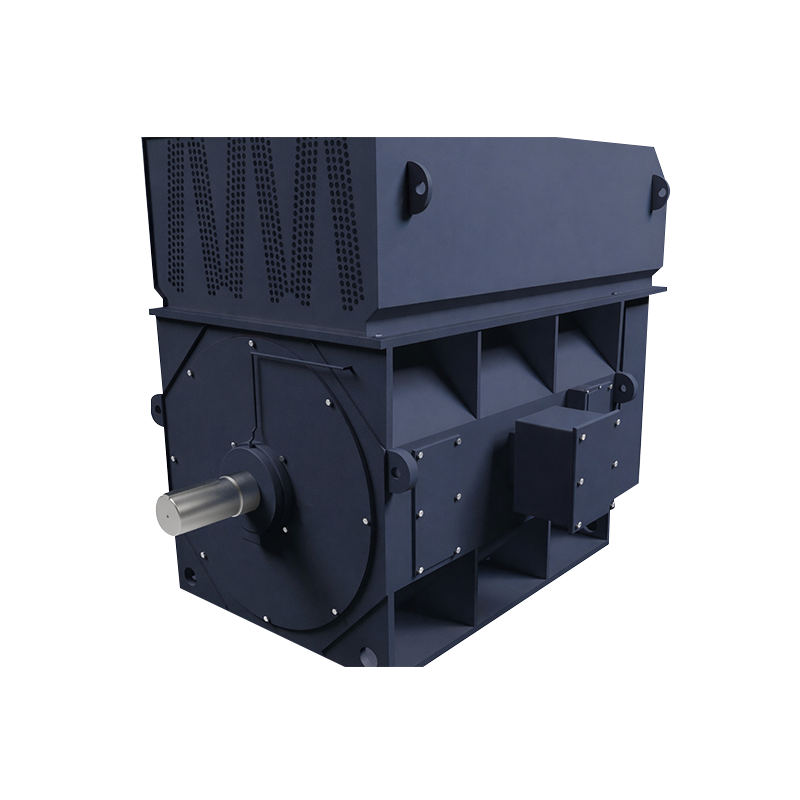
AC Motor vs DC Motor
The fundamental difference lies in power supply and speed control. AC motors run on alternating current and traditionally operate at speeds tied to supply frequency, while DC motors run on direct current and offer inherently simple speed control through voltage adjustment.
| Feature | AC Motor | DC Motor |
|---|---|---|
| Power Supply | AC grid (50/60 Hz) | DC source or rectified AC |
| Speed Control | VFD or pole switching | Direct voltage adjustment |
| Maintenance | Low (no brushes) | Higher (brush/commutator wear) |
| Cost | Lower upfront | Higher (drive + motor) |
| Torque at Low Speed | Moderate (VFD improves this) | Excellent |
| Typical Application | HVAC, pumps, conveyors | Robotics, EVs, servo systems |
Modern variable frequency drives (VFDs) have narrowed the speed-control gap significantly. A three-phase induction motor paired with a quality VFD now delivers smooth variable-speed performance comparable to a brushed DC system, but with far lower maintenance overhead. For fixed-speed or near-fixed-speed applications, AC motors remain the clear default choice in industrial settings.
Types of AC Motors
AC motors divide into two primary families based on how the rotor interacts with the stator's rotating magnetic field:
Induction Motors (Asynchronous)
The rotor current is induced by the rotating magnetic field—no external electrical connection to the rotor is needed. This makes induction motors rugged, low-cost, and virtually maintenance-free. They are the most widely deployed motor type in the world. Subtypes include squirrel cage induction motors (dominant in industry) and wound rotor induction motors (used where starting torque needs adjustment).
Synchronous Motors
The rotor rotates at exactly the same speed as the stator's magnetic field (synchronous speed). Rotor excitation can be provided by permanent magnets (PMSM) or a DC winding via slip rings. Synchronous motors are chosen when precise speed is critical—compressors, large fans, and industrial drives—and they can be operated at unity or leading power factor to correct reactive power on a facility's electrical system.
Universal Motors
Though technically operable on both AC and DC, universal motors appear in small household appliances and power tools where compact size and high starting torque at low cost matter more than longevity. They use brushes and a commutator, so wear is a factor in long-term use.
Reluctance and Hysteresis Motors
These specialty types operate synchronously without DC excitation. Switched reluctance motors (SRM) have gained renewed interest in EV auxiliaries and industrial drives due to their simple, magnet-free rotor construction and fault tolerance.
Induction Motor vs Synchronous Motor
The decisive factor is speed regulation and power factor requirements. Induction motors always run slightly below synchronous speed—this difference, called slip, is typically 2–5% at full load. Slip is what causes rotor current induction; without it, no torque is produced. This makes induction motors self-regulating under varying loads, but their speed varies slightly with load.
Synchronous motors maintain constant speed regardless of load, as long as they remain within their pull-out torque limit. They are the preferred choice in processes where output frequency, timing, or precise positioning is tied to shaft speed—paper mills, textile machinery, large compressors, and clock-driven mechanisms.
From a power factor standpoint, a standard induction motor draws lagging reactive current, worsening the facility's power factor and increasing utility demand charges. A synchronous motor can be over-excited to draw leading reactive current, effectively acting as a capacitor bank and offsetting the lagging loads elsewhere in the plant—a meaningful operational benefit in facilities with heavy inductive loads.
Cost and complexity differ as well. Induction motors are simpler and less expensive; synchronous motors require excitation systems (or permanent magnets) and more sophisticated startup procedures. For most general-purpose applications, induction motors win on value. For high-precision, large-scale, or power-factor-sensitive applications, synchronous motors justify the added investment.
Single Phase vs Three Phase Motor
Phase count affects power delivery, starting characteristics, and efficiency in ways that directly determine which type suits an installation.
Single-phase motors are powered by one AC waveform and do not produce a self-starting rotating field. An auxiliary starting mechanism—capacitor-start, capacitor-run, split-phase, or shaded-pole winding—is required to initiate rotation. They top out practically at around 5 hp (3.7 kW) and are found in residential and light commercial equipment: refrigerators, small pumps, fans, and HVAC blowers.
Three-phase motors receive three offset AC waveforms (120° apart), which naturally produce a balanced rotating magnetic field. This eliminates the need for starting capacitors, improves torque smoothness, and enables power ratings from fractional horsepower to several megawatts. Three-phase motors are inherently self-starting, run cooler, and achieve higher efficiency than equivalent single-phase designs—typically 2–5% higher full-load efficiency at the same power rating.
Three-phase supply is standard in industrial and commercial facilities. Where only single-phase supply is available and three-phase performance is needed, a phase converter or VFD with single-phase input can bridge the gap—though with some efficiency penalty and cost consideration.
How to Choose an AC Motor
Selecting the right AC motor requires matching mechanical, electrical, and environmental parameters to application demands. A systematic approach reduces the risk of undersizing, oversizing, or premature failure.
- Define the load profile: Calculate required torque and speed at startup, running, and peak load. Centrifugal loads (pumps, fans) have low starting torque requirements; conveyors and compressors need higher breakaway torque.
- Determine power rating: Size for continuous duty at the highest expected load. A motor running at 70–85% of rated output is more efficient and longer-lived than one running at 100% capacity continuously.
- Match voltage and phase: Confirm available supply voltage (208V, 230V, 460V, 575V in North America; 380–415V in many international markets) and phase count. Dual-voltage motors offer installation flexibility.
- Assess speed control needs: Fixed-speed applications work well with direct-on-line induction motors. Variable-speed needs require either a multi-speed motor or, more commonly, a VFD-rated motor designed for non-sinusoidal waveform.
- Select NEMA or IEC enclosure: TEFC (Totally Enclosed Fan Cooled) suits most industrial environments. TEBC (Totally Enclosed Blower Cooled) is preferred for VFD applications where the motor runs at low speeds. ODP (Open Drip Proof) works in clean, dry conditions.
- Check efficiency class: Target IE3 (Premium Efficiency) or IE4 (Super Premium) per IEC 60034-30-1. These are now mandatory in most major markets and reduce total cost of ownership over the motor's service life.
- Consider ambient and altitude: Standard motors are rated for 40°C ambient and altitudes up to 1,000 m (3,300 ft). Above these limits, derate the motor or specify a higher insulation class.
AC Motor Torque Explained
Torque is the rotational force an AC motor delivers to its load, measured in Newton-meters (Nm) or pound-feet (lb·ft). Understanding the torque-speed curve is essential for matching a motor to a driven machine without risking stall, overheating, or mechanical damage.
The torque-speed curve of a standard squirrel cage induction motor has several key reference points:
- Starting (locked-rotor) torque: The torque produced at zero speed. NEMA Design B motors typically deliver 150–170% of full-load torque at startup—sufficient for most centrifugal loads.
- Pull-up torque: The minimum torque developed as the motor accelerates from rest to near-operating speed. It must exceed the load's torque requirement at every speed point during acceleration.
- Breakdown (pull-out) torque: The maximum torque the motor can develop before stalling. Standard motors produce 200–300% of rated torque at breakdown. Operating persistently above full-load torque accelerates insulation aging.
- Full-load torque: The continuous torque at rated speed under nameplate conditions. This is the design operating point.
Torque output scales with voltage: a 10% voltage drop reduces available torque by approximately 19% (torque ∝ V²). Sustained undervoltage forces the motor to draw more current to maintain torque, accelerating thermal degradation. Monitoring supply voltage quality is part of effective motor system management.
AC Motor Efficiency Guide
Electric motors account for roughly 45% of global electricity consumption, making efficiency class selection one of the highest-leverage energy decisions in industrial design. The IEC 60034-30-1 standard defines efficiency tiers from IE1 (Standard) through IE5 (Ultra Premium), with most major markets now mandating IE3 or higher for motors above 0.75 kW.
Losses in an AC induction motor fall into five categories:
- Stator copper losses (I²R): Heat generated by current flowing through stator winding resistance. Reduced by using lower-resistance windings and keeping loading below rated capacity.
- Rotor copper losses: Losses in the rotor bars and end rings due to induced currents. Proportional to slip—lower slip means lower rotor losses.
- Core (iron) losses: Hysteresis and eddy current losses in the stator laminations, present at any voltage regardless of load. Minimized by high-grade silicon steel and thin lamination stacks.
- Friction and windage losses: Bearing friction and aerodynamic drag from the fan and rotor. Optimized fan blade design and low-friction bearings reduce these.
- Stray load losses: Miscellaneous losses from harmonic fields, slot effects, and surface losses. Typically 0.5–2% of input power.
A practical efficiency improvement strategy starts with the load factor: motors operating below 40% of rated load see disproportionate efficiency penalties. Right-sizing to operate at 65–85% load consistently delivers better efficiency than specifying an oversized motor for safety margin.
Common AC Motor Applications
AC motors appear in virtually every sector of the global economy. Their reliability, scalability, and low maintenance cost make them the default mechanical drive for countless machine types.
- HVAC systems: Centrifugal fans, blowers, and compressors in commercial and industrial HVAC are overwhelmingly driven by three-phase induction motors, often with VFDs for variable airflow control. Energy savings from VFD-controlled fan systems routinely exceed 30–50%.
- Pumps: Water treatment, chemical processing, oil and gas, and municipal water supply all rely on centrifugal pump systems driven by TEFC induction motors. This is the single largest motor application category by total installed power.
- Conveyors and material handling: Belt conveyors, screw conveyors, and overhead cranes use gearmotor assemblies (AC motor with integral gearbox) for controlled, reliable torque delivery.
- Compressors: Rotary screw, reciprocating, and centrifugal compressors in manufacturing plants and natural gas pipelines are driven by large synchronous or induction motors, often in the hundreds of kilowatts range.
- Machine tools: CNC machining centers use servo-grade PMSM (permanent magnet synchronous motors) for spindle and axis drives, combining the efficiency of AC synchronous technology with precise position and speed control.
- Household appliances: Washing machines, dishwashers, and refrigerator compressors use single-phase induction motors or, increasingly, inverter-driven PMSM for energy efficiency.
- Electric vehicles and traction: Induction motors (as pioneered by Tesla's early models) and PMSMs power traction drives in EVs, rail, and electric bus systems where high power density and regenerative braking capability are required.
AC Motor Troubleshooting Guide
Most AC motor failures are preceded by detectable warning signs. Systematic diagnosis—starting with non-invasive checks before moving to electrical testing—saves time and reduces unnecessary downtime.
Motor Fails to Start
- Verify incoming voltage at the motor terminals—not just at the disconnect. Voltage drops under load can fall below acceptable limits.
- Check phase balance: a voltage imbalance above 2% between phases causes disproportionate current imbalance (typically 6–10× the voltage imbalance percentage) and can prevent starting.
- Test overload relay settings and condition. A tripped overload that resets continuously signals an underlying current issue rather than a nuisance trip.
- For single-phase motors: test start capacitor with a capacitance meter. A capacitor measuring below 80% of rated value is suspect.
Motor Runs Hot
- Measure operating current in all phases and compare to nameplate FLA (Full Load Amps). Sustained current above nameplate is the most common cause of overheating.
- Inspect cooling fins and fan for blockage or damage. A clogged TEFC frame loses significant cooling capacity.
- Check ambient temperature and enclosure ventilation. Each 10°C rise in ambient above the motor's rating approximately halves insulation life.
- For VFD-driven motors: confirm the drive carrier frequency and verify the motor is rated for inverter duty. Standard motors can overheat on VFD output due to harmonic losses.
Excessive Noise or Vibration
- Bearing noise (grinding or rumbling) indicates contamination, inadequate lubrication, or bearing wear. Vibration analysis with an accelerometer can identify bearing defect frequencies.
- Rotor imbalance produces vibration at 1× running speed. Rebalancing after repair or rotor damage is essential.
- Electrical noise (buzzing or hum) at twice line frequency often indicates a shorted turn in the stator winding, a loose connection, or air gap eccentricity.
- Misalignment between the motor and driven equipment generates vibration at 1× and 2× speed and at bearing frequencies. Laser alignment after every coupling disconnect and motor replacement is best practice.
Insulation and Winding Faults
- Perform a megohmmeter (insulation resistance) test between each winding and ground. Values below 1 MΩ indicate insulation breakdown and require rewind or motor replacement before continued operation.
- Polarization Index (PI) testing—comparing 1-minute and 10-minute insulation resistance values—gives a trend picture. A PI below 2.0 suggests moisture contamination or aging insulation.
- Surge testing identifies turn-to-turn faults that megohmmeter testing cannot detect. This is particularly valuable after a motor has been rewound to confirm winding integrity.
PREV:What Is an AC Motor, How It Works & How to Troubleshoot Electric Motors
NEXT:Explosion-Proof Electric Motors: Ex Ratings, Hazardous Location Selection & Standards
NEXT:Explosion-Proof Electric Motors: Ex Ratings, Hazardous Location Selection & Standards
Interested in cooperation or have questions?
Let'S Work Together Welcome Aboard!
-

-
 +86-15021943462
 -
 Room 2326, 23rd Floor 2000 Zhongshan North Road Putuo District Shanghai, China
Join Our Mailing List
Product Categories
Quick Links
Quick Links
