
 English
 中文简体
中文简体 русский

 Read More

Product Category
NEW Category
Contact us
Contact Us
We specialise in the research, development and manufacture of electrical wires and cables.
 +86-15021943462
AC Motor Selection Guide: Types, Applications, and How to Choose
Content
- 1 AC Motor Selection Guide: Types, Applications, and How to Choose the Right One
- 2 Types of AC Motors
- 3 AC Induction Motor vs. Synchronous Motor
- 4 AC Motor vs. DC Motor
- 5 Single Phase vs. Three Phase AC Motor
- 6 Industrial AC Motors and Common Applications
- 7 AC Motor Efficiency
- 8 How to Choose an AC Motor: Selection Checklist
AC Motor Selection Guide: Types, Applications, and How to Choose the Right One
AC motors power the vast majority of industrial equipment, from conveyor drives to pumps and compressors. Choosing the right type — and understanding how it compares to DC and other AC variants — directly affects efficiency, maintenance cost, and equipment lifespan.
Types of AC Motors
AC motors fall into two broad categories: induction motors and synchronous motors. Within these categories, motors are further classified by phase (single phase vs three phase), enclosure type, and speed control method.
2
Main AC motor categories: induction and synchronous
90%+
Share of industrial motors that are induction type
3-8%
Typical efficiency gain from premium-efficiency AC motors
- Induction (asynchronous) motors: the rotor lags slightly behind the rotating magnetic field, making them simple, rugged, and low-maintenance.
- Synchronous motors: the rotor turns at the same speed as the magnetic field, offering precise speed control and higher efficiency at scale.
- Single-phase motors: used for lower-power loads such as small pumps, fans, and household or light commercial equipment.
- Three-phase motors: the standard for industrial equipment, offering smoother torque delivery and higher power density.
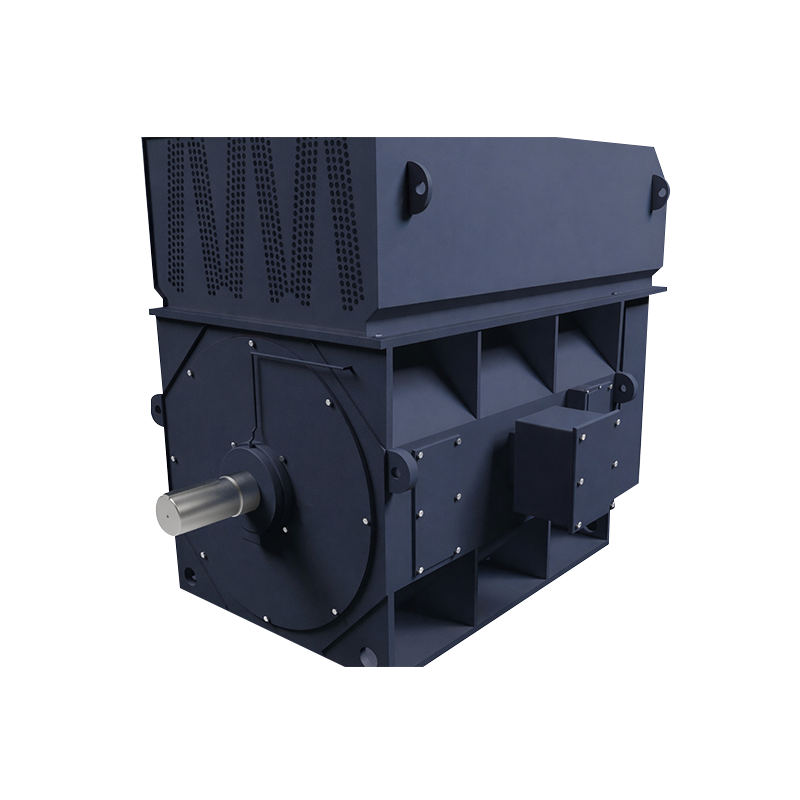
AC Induction Motor vs. Synchronous Motor
Key Distinction
An induction motor generates rotor current through electromagnetic induction from the stator field, which means the rotor always rotates slightly slower than the field itself — a difference known as slip. A synchronous motor uses a separately excited or permanent-magnet rotor that locks onto the stator field and rotates at exactly the same speed, with no slip.
This difference matters in practice: induction motors are simpler and more tolerant of load variation, making them the default for general-purpose industrial drives. Synchronous motors are chosen when precise speed or position control, higher efficiency, or power factor correction is required, such as in large compressors or precision manufacturing lines.
AC Motor vs. DC Motor
| Factor | AC Motor | DC Motor |
|---|---|---|
| Power supply | Alternating current, direct grid connection | Direct current, often requires a converter |
| Maintenance | Low — no brushes in most designs | Higher — brushed types need regular servicing |
| Speed control | Requires VFD for variable speed | Naturally simple speed control via voltage |
| Typical lifespan | Longer, especially brushless designs | Shorter for brushed types |
| Common use case | Industrial drives, pumps, fans, compressors | Precision motion control, small robotics, legacy equipment |
Comparison of AC and DC motor characteristics across common decision factors.
For most industrial applications, AC motors are preferred because they connect directly to standard power distribution, require less maintenance, and scale more cost-effectively at higher power ratings. DC motors remain relevant where fine-grained speed or torque control is needed without the added cost of a variable frequency drive.
Single Phase vs. Three Phase AC Motor
Single Phase
Lower starting torque, simpler wiring, suited to loads under roughly 3-5 HP such as small fans or pumps.
Three Phase
Higher and smoother torque, better efficiency per unit size, standard for industrial machinery above light-duty loads.
Starting Behavior
Single phase motors need a starting mechanism (capacitor or split-phase); three phase motors self-start from the phase offset.
Cost at Scale
Three phase motors cost less per horsepower once above small fractional-HP ratings.
The practical rule is straightforward: if three-phase power is available at the site and the load exceeds a few horsepower, a three-phase motor is almost always the better choice for efficiency, torque smoothness, and long-term reliability.
Industrial AC Motors and Common Applications
Industrial AC motors are built for continuous duty and typically use three-phase induction designs. Common AC motor applications include:
- Conveyor and material handling systems, where consistent torque and low maintenance are priorities.
- Pumps and compressors, where efficiency directly affects energy cost over the equipment's service life.
- Fans and blowers, often paired with VFDs for variable airflow control.
- Machine tools and production lines, where synchronous or servo-type AC motors provide precise positioning.
- HVAC systems, ranging from small single-phase units to large three-phase chillers.
AC Motor Efficiency
AC motor efficiency is typically expressed as a percentage of electrical input converted to mechanical output, with premium-efficiency (IE3/IE4-class) motors reducing energy losses through improved core materials, tighter air gaps, and optimized winding design. Since motors often run for years continuously, even a few percentage points of efficiency gain can outweigh a higher upfront purchase price through lower electricity cost.
How to Choose an AC Motor: Selection Checklist
Key Selection Factors
- Power supply available: confirm single-phase or three-phase supply at the installation site before specifying.
- Load type and torque profile: constant, variable, or high-inertia starting loads call for different motor and starting designs.
- Speed control needs: fixed-speed applications suit standard induction motors; variable-speed needs point to VFD-compatible or synchronous designs.
- Duty cycle: continuous industrial duty requires motors rated for sustained operation, not intermittent-duty designs.
- Efficiency class and total cost of ownership: weigh purchase price against expected energy cost over the motor's service life.
- Environment: ambient temperature, dust, or moisture exposure determines the required enclosure and protection rating.
Matching these factors to the application — rather than defaulting to the largest or cheapest available motor — is what determines whether an AC motor delivers reliable performance or becomes a recurring maintenance cost.
PREV:DC Motors Explained: Working Principle, Types & Brushed vs Brushless
NEXT:Crusher Duty Synchronous & High-Torque Pulverizer Motors Guide
NEXT:Crusher Duty Synchronous & High-Torque Pulverizer Motors Guide
Interested in cooperation or have questions?
Let'S Work Together Welcome Aboard!
-

-
 +86-15021943462
 -
 Room 2326, 23rd Floor 2000 Zhongshan North Road Putuo District Shanghai, China
Join Our Mailing List
Product Categories
Quick Links
Quick Links
