
 English
 中文简体
中文简体 русский

 Read More

Product Category
NEW Category
Contact us
Contact Us
We specialise in the research, development and manufacture of electrical wires and cables.
 +86-15021943462
DC Motors Explained: Working Principle, Types & Brushed vs Brushless
Content
What Is a DC Motor and How Does It Work
A DC motor is an electromechanical device that converts direct current electrical energy into rotational mechanical motion through the interaction of magnetic fields. Current flows through a coil (the armature or winding) positioned inside a magnetic field, and the resulting Lorentz force on the current-carrying conductor produces torque, causing the shaft to rotate.
The working principle relies on a simple feedback loop between electrical and magnetic energy: as current passes through the winding, it generates its own magnetic field that interacts with the motor's fixed magnets (or field windings). This interaction creates a force perpendicular to both the current and the magnetic field, described by Fleming's left-hand rule, which pushes the rotor into continuous rotation as long as current keeps flowing and polarity keeps switching at the right moment.
- Stator: the stationary part, either permanent magnets or electromagnetic field windings
- Rotor (armature): the rotating winding that carries current and produces torque
- Commutation system: mechanical brushes/commutator or electronic switching, depending on motor type, that reverses current direction to sustain rotation
Brushed vs Brushless DC Motors
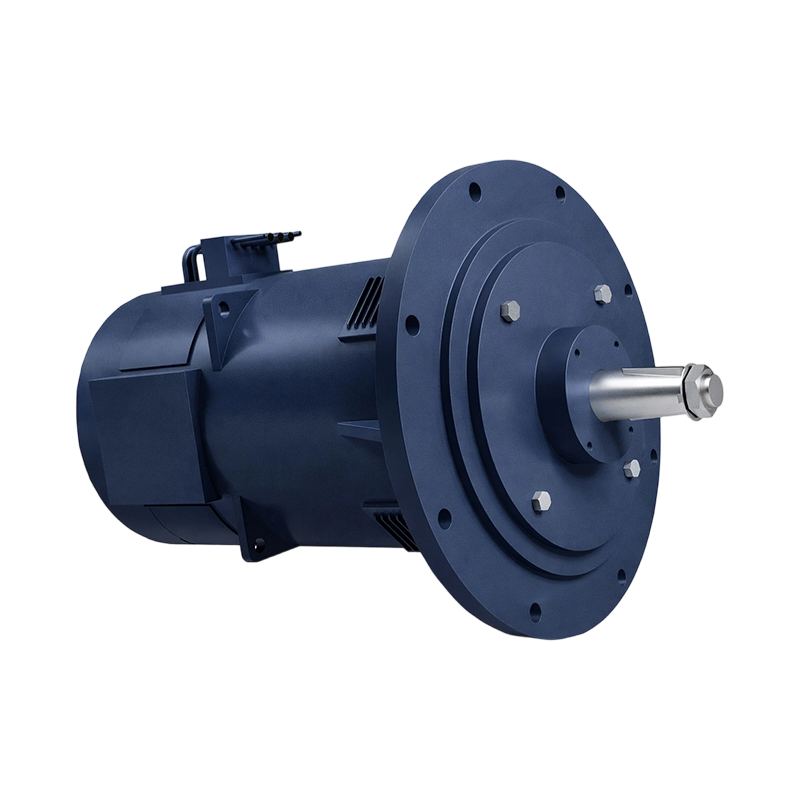
The core difference is how current gets switched inside the motor: brushed motors use physical carbon brushes and a mechanical commutator, while brushless motors use electronic controllers and position sensors. In a brushed DC motor, current is supplied to the rotating armature through spring-loaded brushes that press against a segmented commutator, which mechanically reverses current direction as the shaft turns.
A brushless DC motor flips this arrangement: the permanent magnets sit on the rotor, and the windings are fixed to the stator. An electronic speed controller switches current through the stator windings in sequence, using feedback from Hall-effect sensors or back-EMF sensing to time each switch precisely. Because there's no physical contact wearing down over time, brushless motors last significantly longer and run more efficiently at a given power output.
| Factor | Brushed DC Motor | Brushless DC Motor |
|---|---|---|
| Commutation | Mechanical (brushes + commutator) | Electronic (controller + sensors) |
| Maintenance | Brushes wear and need replacement | No brush wear, largely maintenance-free |
| Efficiency | Lower, due to brush friction and arcing losses | Higher, typically 85-90%+ |
| Control complexity | Simple, works with basic PWM voltage control | Requires an electronic speed controller |
| Typical cost | Lower upfront cost | Higher upfront cost, lower lifetime cost |
Main Types of DC Motors
Beyond the brushed/brushless split, DC motors are also categorized by how the field winding is connected relative to the armature, which shapes their torque and speed behavior under load.
- Series-wound: field and armature windings connected in series; produces very high starting torque, used in applications like starter motors and cranes
- Shunt-wound: field winding connected in parallel with the armature; delivers stable speed across varying loads, suited to fans and conveyor drives
- Compound-wound: combines series and shunt windings to balance high starting torque with reasonable speed regulation
- Permanent magnet DC (PMDC): uses fixed magnets instead of field windings, offering a compact, efficient design common in small appliances and automotive accessories
- Brushless DC (BLDC): electronically commutated, used across drones, EVs, HVAC systems, and precision industrial equipment
Advantages of DC Motors
DC motors remain a preferred choice in many applications because they offer precise, easily controllable speed and torque with a simple voltage-based control scheme. Speed is roughly proportional to applied voltage, and torque is roughly proportional to current, which makes them straightforward to control without complex frequency-based drive electronics — unlike most AC motors.
- High starting torque, especially in series-wound configurations, useful for load-heavy startup conditions
- Smooth, wide-range speed control through simple PWM voltage adjustment
- Compact power-to-size ratio, particularly in brushless and permanent magnet designs
- Simple integration with battery-powered and low-voltage DC systems, avoiding the need for AC inverters in portable equipment
How to Choose a DC Motor
Selecting the right DC motor starts with matching torque and speed requirements to the actual load, not just the rated voltage. Calculate the required torque at the operating speed, add margin for startup and peak load conditions, then check that the motor's continuous torque rating covers that figure without exceeding its thermal limits during normal operation.
- Duty cycle: continuous-run applications need a motor rated for sustained thermal load, not just peak output
- Lifespan requirements: brushless motors suit high-cycle or maintenance-limited applications; brushed motors are acceptable for low-duty, cost-sensitive uses
- Control precision: applications needing fine speed or position control benefit from brushless motors paired with encoders
- Environmental conditions: sealed or IP-rated housings matter for motors exposed to dust, moisture, or vibration
- Voltage and power supply constraints: available battery voltage or DC bus voltage should align with the motor's rated input range to avoid inefficient step-up/step-down conversion
PREV:DC Motor Selection Guide: Torque, Speed, Voltage & Applications
NEXT:AC Motor Selection Guide: Types, Applications, and How to Choose
NEXT:AC Motor Selection Guide: Types, Applications, and How to Choose
Interested in cooperation or have questions?
Let'S Work Together Welcome Aboard!
-

-
 +86-15021943462
 -
 Room 2326, 23rd Floor 2000 Zhongshan North Road Putuo District Shanghai, China
Join Our Mailing List
Product Categories
Quick Links
Quick Links
